
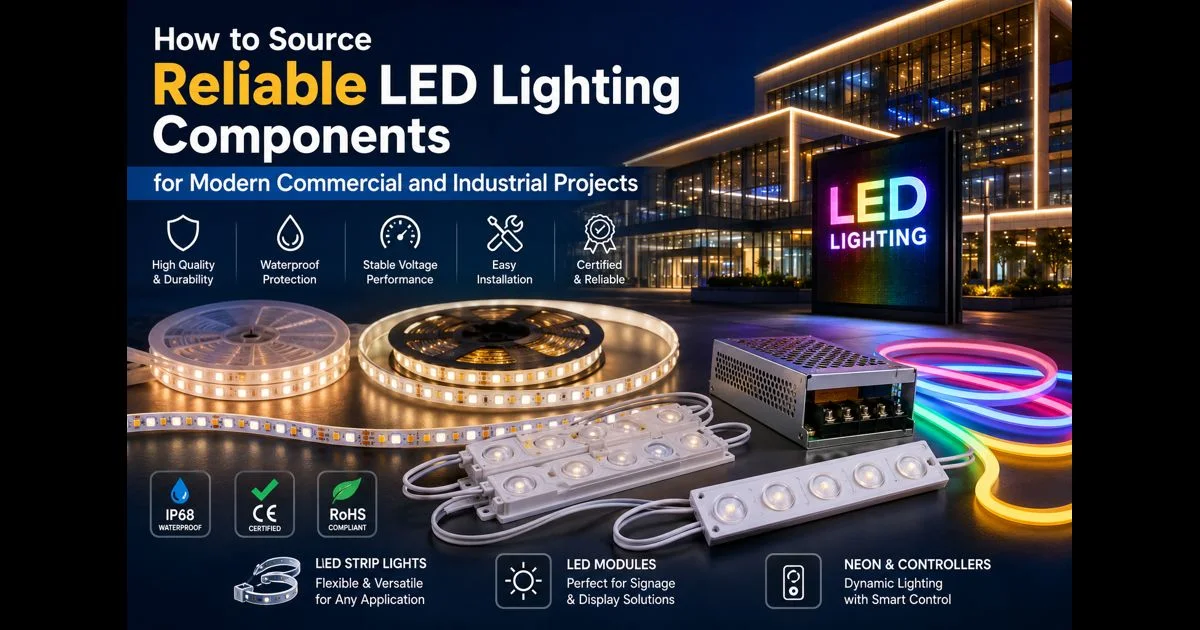
The demand for LED lighting continues to grow across commercial, industrial, architectural, and residential sectors. From retail displays and office buildings to outdoor signage and decorative installations, LED technology offers energy efficiency, long service life, and flexible design possibilities. However, the success of any lighting project depends heavily on selecting reliable components that meet performance requirements and industry standards.
Choosing the right lighting products is not only about brightness or appearance. Factors such as durability, voltage stability, waterproof protection, installation flexibility, and manufacturing consistency all play a role in determining long term results. Understanding these factors can help buyers, contractors, and project managers make informed decisions when sourcing LED lighting solutions.
Why Product Quality Matters in Every Lighting Project
Quality remains one of the most important considerations when purchasing LED lighting components. Poor quality products often experience uneven brightness, shortened lifespan, color inconsistency, or premature failure. These issues can increase maintenance costs and create unnecessary project delays.
Reliable manufacturers implement testing procedures to verify product performance under different operating conditions. This is particularly important for large scale installations where lighting systems must perform consistently for years. Certifications, material quality, and production standards provide useful indicators when evaluating potential suppliers.
LED products are used in a wide range of environments, including indoor commercial spaces, outdoor architectural lighting, entertainment venues, and signage applications. Each environment requires products designed to withstand specific operating conditions while maintaining stable performance.
Understanding Different Types of LED Strip Lights
LED strip lights are among the most versatile lighting products available today. They are commonly used for cove lighting, architectural accents, pathway illumination, decorative displays, and home improvement projects.
Several strip configurations are available to suit different applications. For example, 3528 LED strips feature 300 LEDs per 5 meters and consume approximately 4.8W per meter, making them suitable for energy efficient ambient lighting. Meanwhile, 5050 LED strips provide higher brightness levels and are often used in architectural projects, signage, and decorative installations.
Modern COB LED strips have also become increasingly popular. Compared with traditional SMD strips, COB technology produces continuous illumination without visible light spots, creating a cleaner visual appearance. COB strips are also easier to maintain and provide excellent lighting uniformity. Free cutting COB LED strips are particularly useful because they help resolve installation constraints that often occur in custom lighting projects.
When evaluating manufacturers, buyers often look for an experienced LED Strip Lights exporter capable of providing multiple product options for different environments. Features such as IP65 and IP68 waterproof ratings, high quality copper PCB construction, and stable voltage performance are important indicators of product reliability.
One practical example is the use of IP68 waterproof LED strips. When illuminated at depths of up to 3 meters, these strips remain protected from water ingress, helping prevent damage to internal circuitry while maintaining safe operation in demanding environments.
Choosing the Right LED Modules for Signage and Display Applications
LED modules are widely used in illuminated signs, channel letters, advertising displays, light boxes, and decorative architectural features. Their compact design allows installers to achieve consistent brightness across different display formats while maintaining energy efficiency.
Factors such as brightness output, beam angle, waterproof protection, operating voltage, and lifespan should be carefully reviewed when selecting modules. For example, SMD5050 RGB modules offer rich color output, a 180 degree beam angle, and an operational lifespan that can reach 50,000 hours under proper conditions.
Businesses searching for dependable LED Module suppliers should focus on product consistency, testing procedures, and technical documentation rather than price alone. Reliable modules help reduce maintenance requirements and improve the overall appearance of illuminated displays over time.
Applications for LED modules extend beyond advertising. They are commonly found in shopping malls, decorative building outlines, retail environments, staircases, furniture lighting, stage effects, cafes, and entertainment venues. Their flexibility makes them an important component in modern lighting projects.
Key Factors to Compare Before Selecting a Manufacturing Partner
Several factors should be considered when evaluating a lighting manufacturer. Production capabilities, quality control systems, technical support, and delivery performance all influence project success.
Shenzhen Dekingled Co., Ltd., established in 2014, manufactures a wide range of LED lighting products including strip lights, modules, neon lighting, controllers, and COB solutions. The company operates from the 4th Floor, Building C, SanMing Industrial Park, Shiyan Town, Bao’an District, Shenzhen, China.
A notable product in its portfolio is the free cutting 12V and 24V COB LED Strip, which provides greater installation flexibility for custom projects. Technical support and efficient delivery processes are also important considerations when evaluating manufacturing partners, especially for projects with strict timelines.
Another factor worth examining is voltage selection. Many installers prefer 24V systems because voltage drop remains minimal over longer distances. In contrast, 12V systems experience greater voltage drop, which may cause brightness reduction toward the end of extended strip runs.
How Certifications Help Ensure Product Reliability
Industry certifications provide additional assurance regarding product quality and compliance. Standards such as CE, RoHS, and quality management certifications help verify that products meet recognized manufacturing and safety requirements.
Certifications alone should not determine purchasing decisions, but they offer valuable insight into a manufacturer’s commitment to quality processes and product consistency. Combined with technical specifications, testing data, and production experience, they help buyers assess whether products are suitable for commercial and industrial applications.
Final Thoughts
Modern lighting projects require more than simply choosing bright LED products. Careful consideration of product quality, installation requirements, waterproof protection, voltage stability, and manufacturing standards can significantly improve project outcomes.
Whether sourcing LED strip lights for architectural applications or LED modules for signage projects, selecting reliable components helps ensure consistent performance, reduced maintenance, and long term operational efficiency. By focusing on technical specifications and manufacturing quality, buyers can make informed decisions that support successful lighting installations across a wide range of environments.
Leave a Reply